
The Indigo Crisis: A Wake-Up Call for Government Presence in Business?
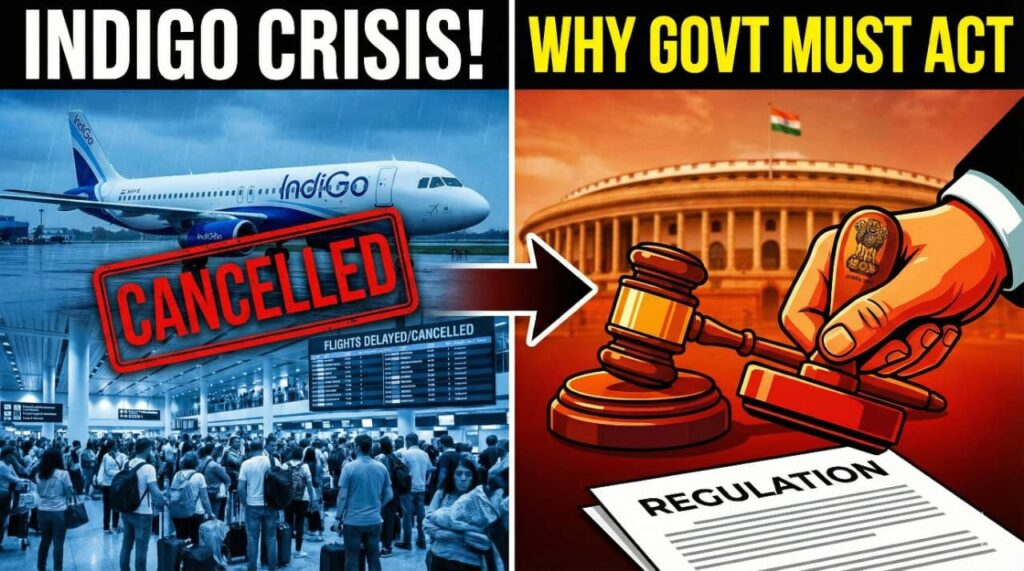
If you have glanced at a newspaper or scrolled through social media in the last few days, the chaos in the Indian aviation industry is impossible to miss. The scenes at our airports have been described as worse than bus stands or railway stations. Passengers are stranded, flights are non-existent, and perhaps most distressing of all—luggage is missing. People are left without their belongings, some even unable to access their house keys locked inside their checked bags.
But beyond the immediate frustration and the operational collapse of Indigo, this crisis points to a much larger economic question: Should the government really exit the business sector entirely?
The Monopoly Problem
The current situation has highlighted a critical vulnerability in our aviation sector. Indigo holds a massive stake—over 60%—of the market. When a single private player with such dominance collapses or faces technical failure, the entire country comes to a standstill.
As passengers, we have two options: scream at the airline (which is already overwhelmed) or look to the government for relief. But here lies the problem: the government currently has no “business” in the skies. With the sale of Air India, the state has exited the sector, leaving passengers with no public sector alternative to fall back on during a private sector failure.
The Real Estate Contrast
Contrast this with the Real Estate sector. If you look at regions like Noida or Delhi, you see a healthy mix of players. You have government bodies like the Noida Development Authority, Yamuna Authority, UP Awas Vikas, and the DDA (Delhi Development Authority) offering affordable and regulated options.
Simultaneously, you have premium private players like Godrej, Sobha, and Lodha. In this sector, there is no monopoly. The government is an active participant, ensuring that while luxury exists, affordable housing remains accessible. The presence of the government acts as a stabilizer.
Rethinking “Privatization”
There is a popular narrative that the government should shut down all its businesses and leave everything to the private sector—from airlines to schools. But is this wise?
Private schools and hospitals are often criticized for high costs and exclusivity. If the government exits these sectors entirely, the common citizen loses their safety net. The video makes a poignant analogy: A school principal is only effective if they also know how to teach. Similarly, a government can only effectively regulate and understand the problems of a sector if they are actively involved in running a business within that sector.
The Lesson from Crisis
We don’t have to look back far to see why government involvement matters. During the COVID-19 pandemic, it was government employees and public sector infrastructure that stood on the front lines when the world shut down.
The current aviation crisis is a harsh reminder that a complete government exit from essential services leaves the public vulnerable to monopolies. Perhaps it is time to rethink the strategy. For the sake of stability and consumer protection, maybe the government needs to keep a seat at the table—in every sector.
What do you think? Should the government restart its own airlines to prevent monopolies, or is full privatization still the way to go?
Source Video: https://youtu.be/kyzmqTC0uqs?si=zVbLAeNu1tziC0AP